
Published By:
Lamont Jack Pearley
African American Tribal Music
What I once called African American Tribal Music — a term that sought to name the deep, complex musical expressions of Black people in America — is now sharpened by the theoretical lenses of Blues Ecology, Blues Narrative, and Black Southern Afro-Indigenous epistemologies. These frameworks allow us to understand our music not as borrowed or preserved from Africa, but as a fully formed Black American cultural expression, born of the specific histories, landscapes, spiritual systems, and political struggles that shaped our people on this land.
The Blues was born in America. It did not sail over on slave ships. It was not simply retained from African tradition. Rather, it was created by Black Americans in response to the violence, displacement, labor, and longing experienced in a colonized nation. While African cosmologies and musical sensibilities live within us, the Blues is ours. It is Black American music, created here, shaped here, and rooted here.
Blues Ecology: Sound, Soil, and Survival
Blues Ecology is the theory that Black musical expression, especially the Blues, emerges from a uniquely Black American interaction with place, labor, spirituality, and memory. The call of the Blues echoes across cotton fields, prison yards, levees, juke joints, and city streets. It’s not a transplanted sound. It’s a sound that grew out of the soil of the South, fertilized by suffering, survival, and spirit.
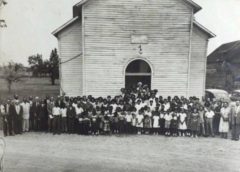
Bush Meetings, spirit-filled, unsupervised gatherings for worship, were sites of cultural retention and cosmological grounding. They were more than ritual; they were resistance. The line singing that emerged from those gatherings, along with the call-and-response of work hollers and moans, reflects an enduring African worldview adapted into Black American lifeways. Music, in this ecology, is not performed for entertainment; it is performed to live. It is a technology of survival, rooted in rhythm and relationship.
This ecological system connects song, land, labor, and community. It recognizes that the Blues is not a genre frozen in time, but a living, breathing practice that responds to environmental change, structural violence, and generational memory. Blues Ecology insists that to understand the music, we must understand the ecosystems, physical, cultural, and spiritual, that gave rise to it.
The Blues Narrative: Testimony, Tradition, and the Sound of Struggle
The Blues Narrative is the unfolding story of Black life told through music, a narrative rooted not in mythology or abstraction, but in material history. It begins with the sounds of the enslaved in the fields and continues through the movements, migrations, and revolts of their descendants. As Clyde Woods argued, the Blues encapsulate a people’s epistemology, a way of knowing forged through resistance to plantation economics and racial capitalism.
Blues is not merely a musical form; it is an epistemological practice, a way of speaking truth to power, a method of preserving memory. It testifies to four major historical ruptures that reshaped Black American cultural expression: the Transatlantic Slave Trade, Emancipation and Reconstruction, Jim Crow and the Great Migration, and the rise of the prison-industrial complex. These events changed not only our music but also the conditions under which our music was made.
As W.E.B. Du Bois wrote in The Souls of Black Folk, the “Sorrow Songs” are expressions of a people striving for more than survival — striving for justice, for freedom, for God. That striving never stopped. It simply changed keys.
Black Southern Afro-Indigenous Continuities
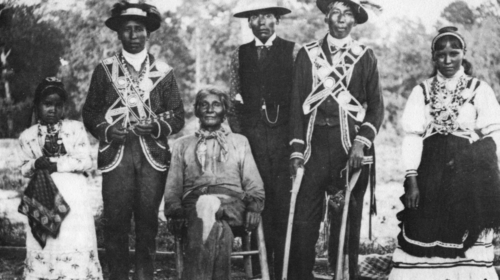
Many of us descend not only from West African ancestors but also from the Indigenous peoples of the Southeastern woodlands and from spiritual lineages that connect to the Hebrew tribes and diasporic cosmologies. Our music reflects these multiple origins. To call it “tribal” is to acknowledge our layered identities and right to name our practices on our own terms.
The ring shout, for example, is a spiritual technology fusing African dance with Indigenous movement, performed in a counterclockwise circle to conjure ancestors. The “blue” notes of blues music, bent, mournful, and filled with feeling, are not deviations but declarations of our distinctiveness. These tonalities and rhythmic patterns are not borrowed; they are ours. They emerged here, under these conditions, in these bodies.
From Collection to Reclamation
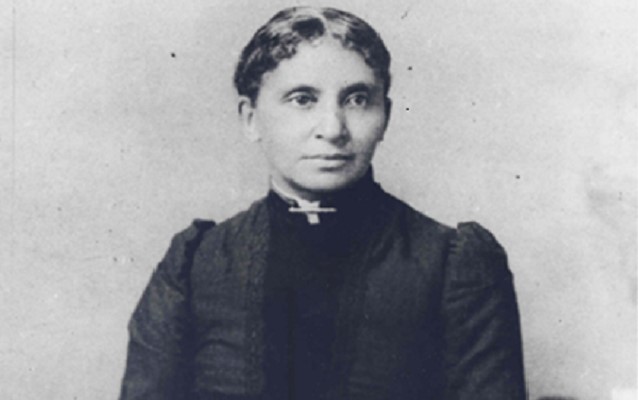
While early collectors like Charlotte Forten Grimké, William Allen, and the Lomaxes recorded what they called “slave songs,” they often did so through extractive and paternalistic lenses. We were never voiceless. We were never without theory. Zora Neale Hurston, John Wesley Work III, and today’s community-based folklorists and ethnographers remind us that Black people have always interpreted and documented our own culture.
The music recorded on plantations, chain gangs, and rural porches is not an artifact; it is an archive. It is not frozen in the past; it is a blueprint for our future. Blues Ecology and Blues Narrative call us to move beyond preservation toward protection, reclamation, and regeneration.
Blues as a Living Theological and Political Practice
James Cone argued that the Blues are a form of secular theology — songs that question white Christianity while affirming a divine presence rooted in justice and deliverance. The so-called “devil songs” of the secular slave tradition were not godless; they were God-aware. They were skeptical of the colonizer’s god, but faithful to the Most High of the oppressed.
Bush Meetings, field hollers, spirituals, and blues all share this spiritual-political lineage. They are moments where theology meets ecology, where faith meets function, where song meets soil. The modern Blues singer — whether in a juke joint or on YouTube — carries this lineage.
The lyric still rings true: I ain’t got no money / another man got my woman / I ain’t got nothin but some whiskey / my guitar / and dem Blues. But now, we carry more than sorrow. We carry theory. We carry lineage. We carry land.
We Are Still Blues People
The evolution of African American Tribal Music cannot be understood without the frameworks of Blues Ecology and Blues Narrative. These theories center Black southern cosmology, environmental memory, ancestral intelligence, and resistance traditions. They affirm that our music — from Spirituals to Blues, from field hollers to hip-hop — is a distinctly Black American expression.
Born of struggle, rooted in soil, alive with spirit, our music remains a living archive. We are not reviving tradition. We are still living it.
We are still Blues People. And the land is still listening.